
cocoon: One Summer of Girlhood Movie Review - Flowers in Place for Blood
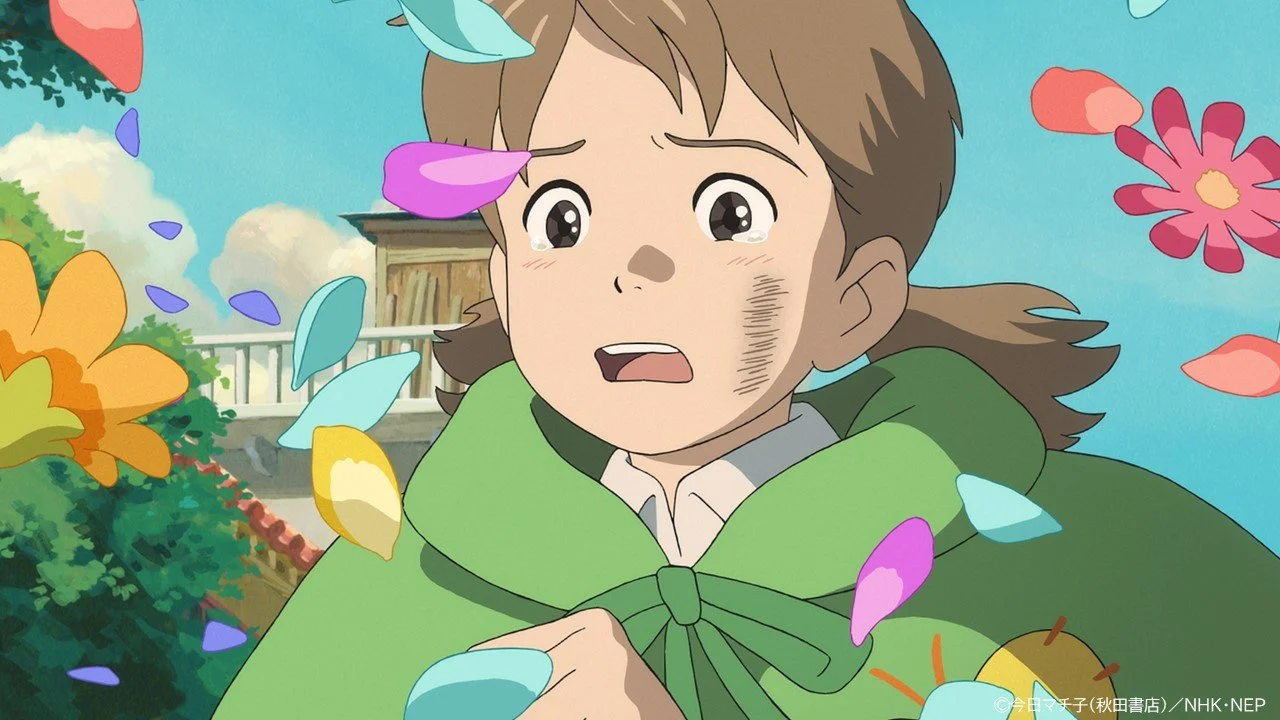
Witnessing a massacre, San’s imagination masquerades the bloodshed of others into flower petals.
By Jonathan “Joestar” Beltran
Anime has its fair share of WW2 films documenting the grief, terror, and at times condemnation on the youth for not understanding the plights of the war-torn generation. Works such as Grave of the Fireflies, In This Corner of the World, and Barefoot Gen (and even popular live-action Japanese films like the original Godzilla including its 2023 reboot Minus One) point to the devastation that war brings upon its people and collective nation. cocoon: One Summer of Girlhood is both no different yet separates itself from its brethren to aim at being wholly universal; the war being a fictional one.
cocoon: One Summer of Girlhood follows San, a demure - almost to a fault - girl that helps at an all-girl labor camp in the middle of a World War II-esque conflict. Her best friend, Mayu, a fellow laborer who just arrived at the island six months ago, provides camaraderie, support, and confidence in San’s observations, warnings, and concerns. Whether it be carrying dirt and supplies to the next station or alerting incoming enemies in the skies, everyone here is in equal parts playful during the workday and fearfully prepared for the impending strike. These two, with a particular emphasis on San, are the crux of the narrative as they go from labor camp to a makeshift hospital in a cave to eventually evacuating both in search for safety at the cape; the long journey that involves every one of the girls.
Upon first glance, you would immediately think of Ghibli’s, more specifically Isao Takahata’s, masterpiece Grave of the Fireflies. After all it is set in a World War II-esque conflict following children/teenagers as they try to survive. While it may draw a few parallels including the aforementioned, it is surface level at best. Grave of the Fireflies opts for more of a slice-of-life approach, witnessing two orphans try to get by the day amidst surprise bombings, starvation, homelessness, and spiritual regret. I see cocoon similar to that of the humanistic preservationist morals of Children of Men and the brutal opening scenes of Saving Private Ryan. Both operate within the ebb and flow of perseverance in damning situations and have no qualms in revealing the level of violence.
Surprisingly, cocoon is very brief, clocking in around an hour. It does not overstay its welcome and delivers what it wants to say in a timely, well-paced manner. Structurally the film adaptation eases you into the plight and as soon as the first death comes the more gruesome it gets. And as the violence escalates so does the desperation between San and Mayu.
San bears the brunt of audience surrogate; unsure of the potential calamities yet suffers through hell and high water. That is not to say she is unremarkable or bland, rather I find her well-suited in a narrative like cocoon. Her presence is akin to an invitation to the warmth shared amongst the girls and the disaster that comes along the way. At every point you, much like her, get the urge to stay or run; speak up or keep silent.
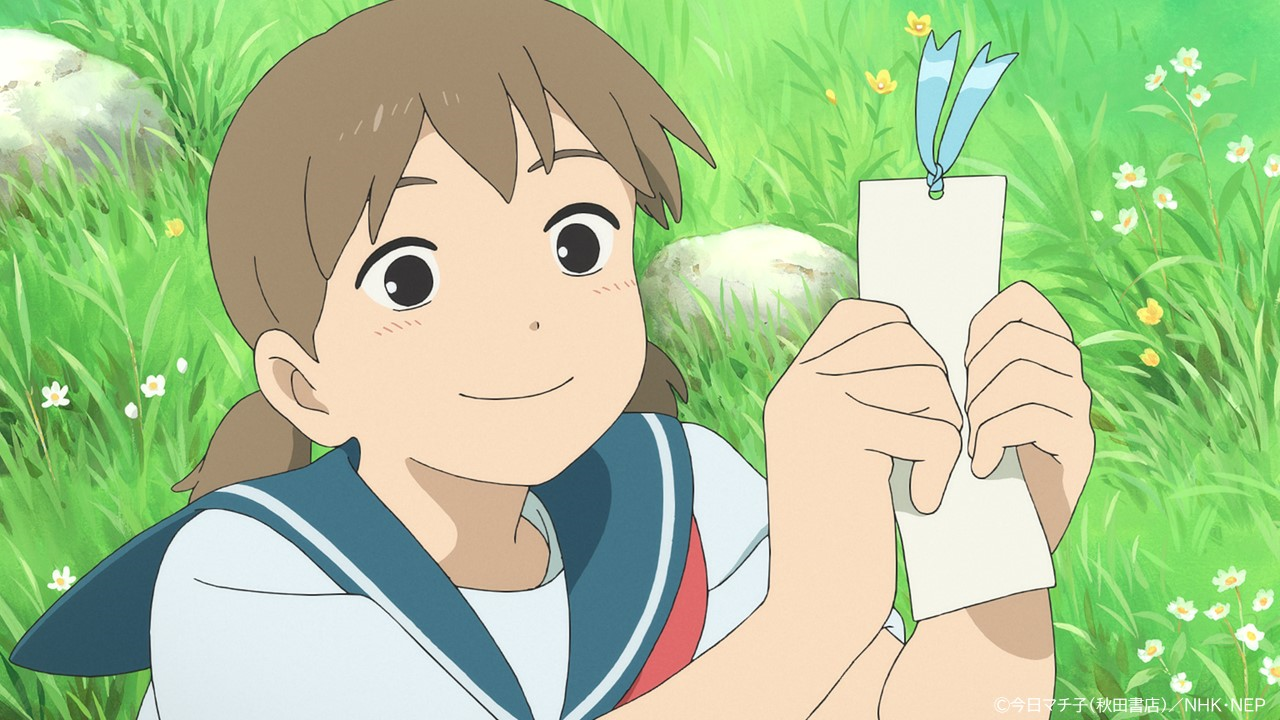
San holding up a her handmade bookmark
An important fixation of hers is the lifecycle and use of silk worms: they are nurtured and raised to the point where they cover themselves in a cocoon of their own making to which one of two outcomes happen: most of these cocoons are boiled alive to harvest their silk and the few preserved burst out of their cocoon with flightless wings - thanks to the human process - to eventually birth out more silk worm pupa. This metaphor fleshes out gradually and brutally - the girls are directed to care for the wounded soldiers as bombs fall above ground; a good number of them tireless, some wounded, and one dead due to being caught in the explosion. At the height of the bombings a fellow laborer confronts an already overwhelmed San that what we do is for the “good of the country” as the country provides education and food, ergo there is no time to slack. All of this contributes to San's meltdown; burdened by the loss, guilt, and shame. To sum it up, if she knew what the world was like she’d “never get out of the cocoon and slowly die.” cocoon is witnessing San’s personal metamorphosis in a time of national crisis, active gunfire, and disillusionment.
The question becomes whether or not you are moved by San’s shift from cowardice to courage by the end. After watching it, I can say I was mildly moved. I think my reservation stems from two points: the movie is brief and the ending is to be expected. San does become strong though more so out of the frustration and confusion of people willing to die than live, hearkening back to her preference in the silk worm metaphor, yet this happens by the tail end of the movie, roughly 10 minutes to spare. To me it is rather quick and does not allow time for me to settle with her newfound confidence in life. And the ending, specifically the messaging, is obvious - San’s journey must be one of self-realization and growth from the terror she experienced. It is not bad, rather it is relatively straightforward and lacks a lot of the nuance its other peers have.
The film, for the most part, stays true to the manga’s core theme: Life is worth living beyond the cruelties of war and the lofty imagined safety. As soon as the girls approach a ruined town ravaged by the enemy, they are met within minutes a flurry of bullets to which San, under Mayu’s kind suggestion - dare I say ‘spell’ - to envision blood in the form of flower petals, sees her friends majestically massacred in a flurry of soft botanical color: whites, yellows, reds, blues, and purple; innocently spilling out of their bodies as they run for their lives.
Surprisingly enough, this scene and the ‘flower for blood’ substitution is wholly unique to the film as the manga has no qualms of displaying the gore on display. When I interviewed director Yukimitsu Ina and producer Hitomi Tateno about this creative choice, what it boiled down to was a movie “that teenagers could watch or the younger generation could watch. So then I wanted to not lean towards the shocking elements or the grotesque elements but more for the drama and the story.” Ironically, NHK had little to no restrictions regarding the content, according to producer Tateno-san, rather this was more or less a case for watchability as the manga’s depiction of the violence was “too direct.” As for the aforementioned flowers it was a combination of multiple ideas: 1) “What’s something beautiful and also scary? (Tateno-san), 2) a casual conversation about flowers, and 3) E.T. more specifically how the alien E.T.’s health is connected to the flower. In execution it works wonders. There is a genuine horror when watching this scene unfold. More particularly, one wherein San and Mayu hide behind a wooden fence only for bullets and flowers to pierce through. Now imagine that without the flowers, shocking right? To me I think their choice furthers the motif of the power of imagination; how it becomes a coping mechanism for the world around.
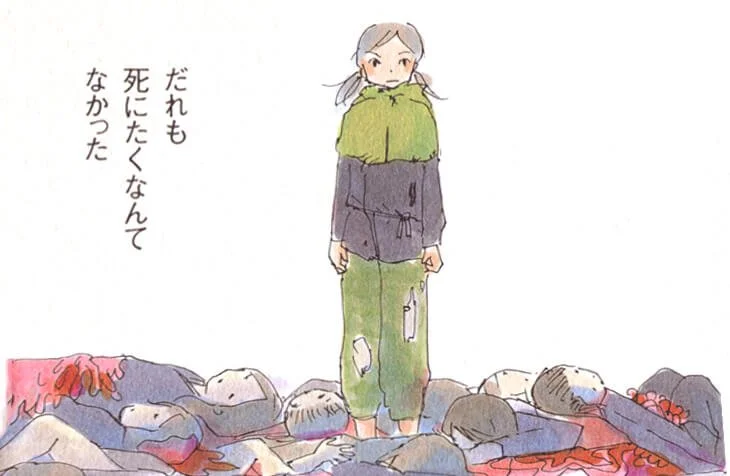
cocoon manga by Machiko Kyo
Yet the film’s artistic choice complements the heart behind its source material as the soft rounded features found in Studio Ghibli’s style provide a great contrast between the fragile innocence of girlhood/youth and the atrocities an impersonal enemy can do to kill it. To me it is witnessing the wonder and whimsy felt by Ghibli’s typical brand image purposefully being torn apart by the realities of war. It is no surprise seeing this aesthetic considering Hitomi Tateno is a Studio Ghibli veteran who worked on titles such as My Neighbor Totoro, Princess Mononoke, and Spirited Away to name a few.
Compared to its anime contemporaries, cocoon has a different theme: An imagination can carry one beyond the tragedies of war and become a springboard for a new life and hope to emerge amidst the carnage. In a time where multiple wars and conflicts are happening across the globe cocoon is another prescient film which, on one hand, is in league to many a great Japanese war movie and on the other hand, is just another war film. The lingering question I have is: how many more of these do you need to get the point across? cocoon admittedly echoes a lot of what has already been said that runs cliche to a seasoned viewer. Yet a detail from the film’s composer, Kenuske Ushio (Chainsaw Man, A Silent Voice) sheds some light on the matter: “war is something that is so far away from Japan or typical Japanese people.” Even though I am not a Japanese citizen, there is a resonance to what is said. Perhaps it reflects my calloused disenchantment within me - only exposed to war through the medium of entertainment. I do not hope to experience much of what happens in any of these films, yet they serve as reminders of the privileged life I have safe and free from the extremities of war, even if said films preach to the choir - this one, for as much excellent execution as it has, is included.
Another point of contention is more so of the different focuses between the manga and its film adaptation. The manga left a deeper impression on me as it addresses the irony of imagination: how an urgent ‘otherness’ driven by your own nation can drive its own people into lunacy. In short, the manga observes the dismantling of the collective consciousness about the enemy while the film focuses on one character’s pursuit for life beyond the tragedy. Same story - for the most part - with two different perspectives and approaches.
cocoon demands you to wrestle with an age-old practice of awareness of both the preciousness of life as well as its fragility in the midst of war. The senseless violence can be painted over with a spark of imagination, yet eventually the cruelty must be confronted with a boldness that dares to see the blood oozing out of your dearest friends and the enemy’s own humanity, even as he points a gun at you.
cocoon: One Summer of Girlhood premieres in theatres 4 September 2026. Tickets here.
cocoon manga by Machiko Kyo is published by VIZ Media under their VIZ Signature Edition imprint.
Many thanks to:
Yukimitsu Ina, Hitmoi Tateno, and Kensuke Ushio for their time.
Hannah Mancinelli and Joe Incollingo of 42 West LLC for the interview opportunity and coordination.
Grace Liriano and Rae D’Agnillo of GKIDS for the screener.