
cocoon: One Summer of Girlhood Interview with Director, Producer, and Composer
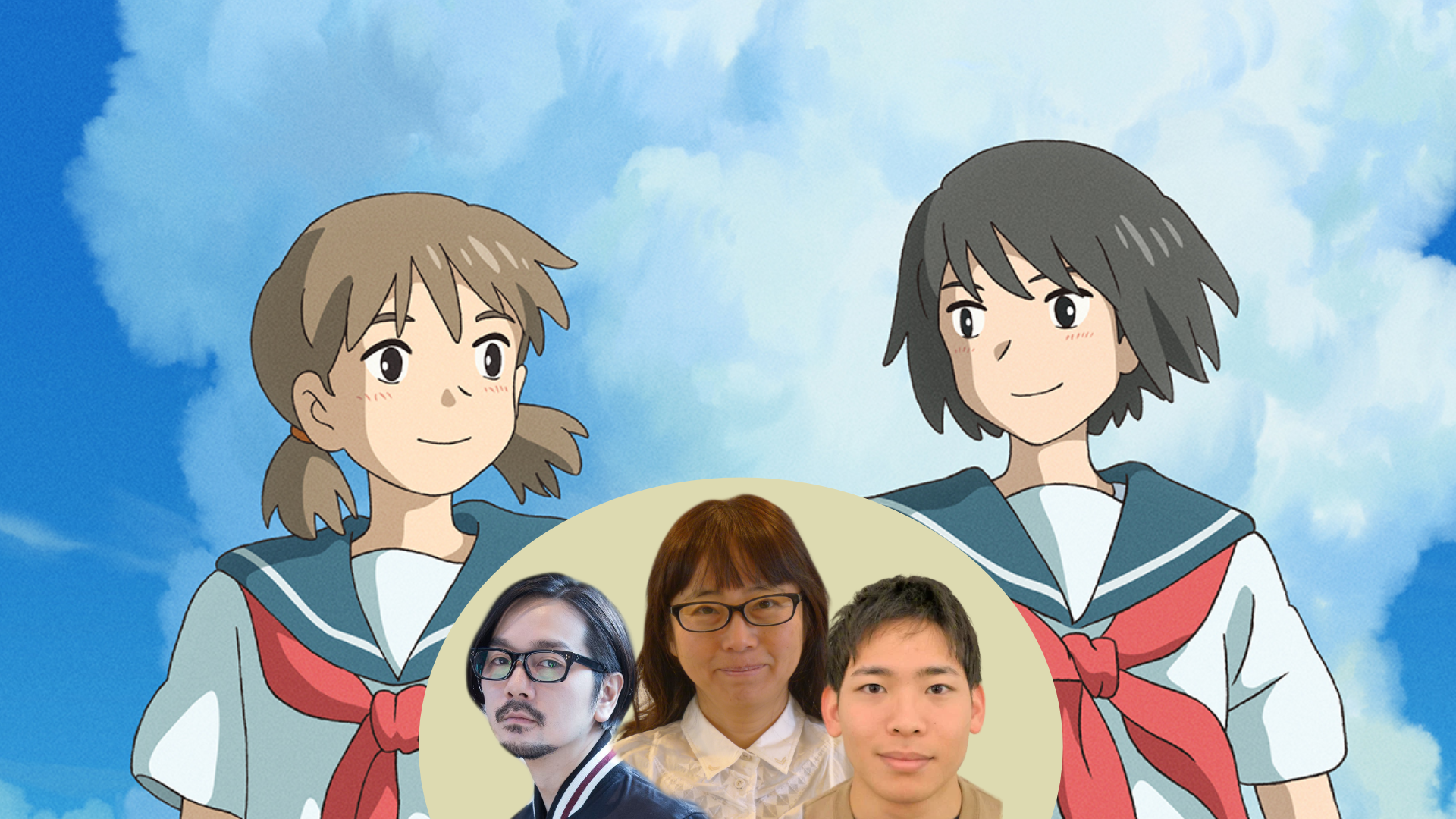
From Left to Right: Composer Kensuke Ushio; Producer Hitomi Tateno; Director Yukimitsu Ina
by Jonathan “Joestar” Beltran
Your backdoor anime hangout had the privilege and honor to interview the creative team for the upcoming film, cocoon: One Summer of Girlhood. You’ll find that this is a film of surprising firsts: how this is the directorial debut of Yukimitsu Ina (animator for Star Wars: Visions); how producer and founder of the newly built animation studio Sasayuri, Hitomi Tateno, entrusted Ina-san and veteran composer Kensuke Ushio (Chainsaw Man, Dan Da Dan) to work on the studio’s debut feature length movie. May you come out enriched reading this!
cocoon: One Summer of Girlhood comes out on 4 September 2026. Click here for tickets
Otaku Hourly (OH): Ina-san, Tateno-san, and Ushio-san it is a privilege and an honor to have you all on the program, to be one of your promotional avenues for your upcoming film cocoon.
Question to Tateno-san, as the founder of Studio Sasayuri, what qualities did you see in Ina-san and Ushio-san that made you entrust them with your studio’s debut feature length film?
Hitomi Tateno (HT): It's really hard to say in just a few words, but starting with director Ina. So he's a very young director, but he has this sense or taste that is very veteran-like. So I sometimes feel like as I watch him, I feel like he's like this older director. But I think he really gets that because he analyzes and studies the previous directors that came before him, all of their works, and he absorbs them very well. So he takes all of his directors, senpai directors, good parts, only the good parts, and really just absorbs it. And you could really see that in his work.
For Ushio-san, I didn't watch all of his works, since he has so many. But with cocoon, I really feel like he was able to incorporate what the director and the sound director wanted, which was coming up with simple, natural sounds to compose. Because I feel like with cocoon, he could have done all these different things. But then yet, he really was able to make a distinct soundtrack that is different from everything else that he has done. I'm so sorry, as my vocabulary to describe his greatness is very limited, but I feel like he was able to achieve a “less is more" effect with the soundtrack. It was very natural. Yeah, this naturalness of the film was really showcased in his composition.
Kensuke Ushio (KU): (To Tateno-san) Thank you very much.
(Group laughter)
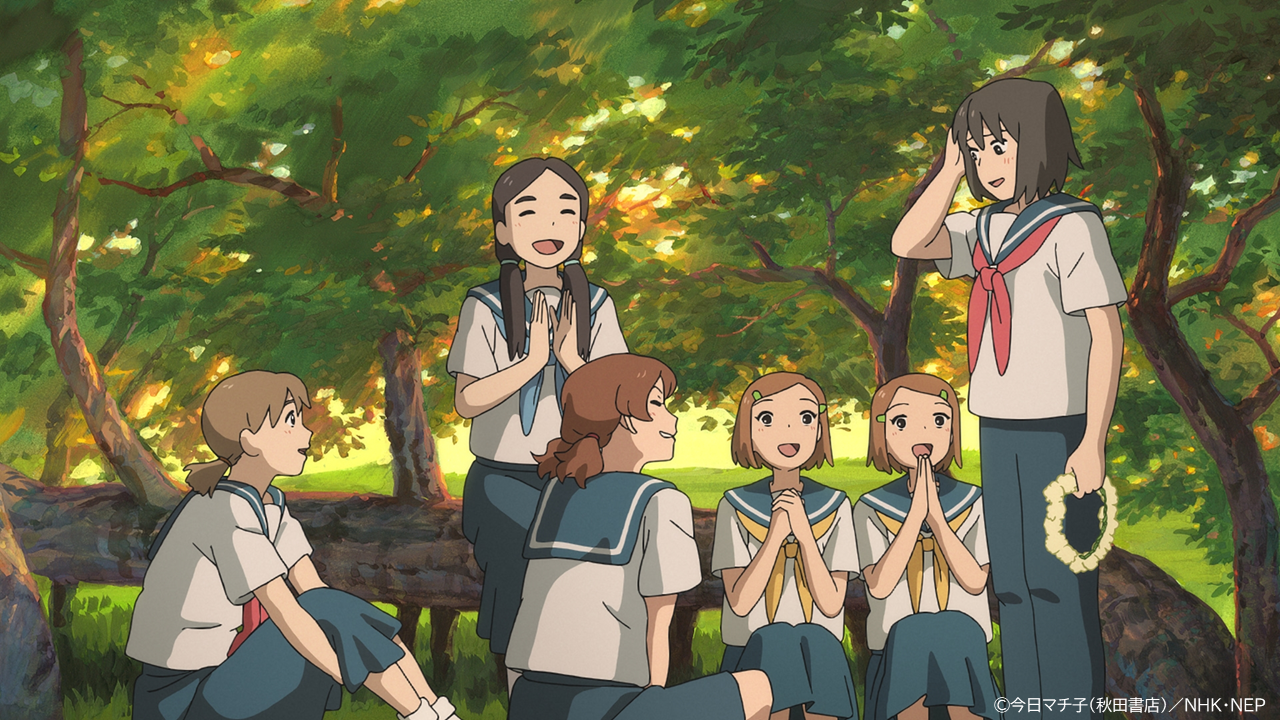
From left to right: San, Hina, Tamaki, Mari, Yuri, and Mayu.
OH: Very kind words.
Question to Ina-san, this is your debut as a director. Congratulations!
How did you get the opportunity to do this, and how do you feel afterwards? How do you feel about directing this?
Yukimitsu Ina (YI): Actually the opportunity was very casual to me. There was nothing dramatic that happened. I was given this manga and was asked, “What do you think about it?” And I actually have this tendency - it's part of my way of studying - [that] when I have something that I'm interested in, whether it be a manga or some textbook or something, I would put it into illustrations or storyboards just as an exercise. So then when I got the manga, that's what I did. I didn't have any intentions to be like, “Oh, I'm going to make this into an anime.” I was just really doing my exercises. Maybe for about a week, I was drawing a few storyboards, image boards, and illustrations. And we were just talking casually like, “Oh, I think if we do this and do this, it'll become a good anime film.” And that's how the whole process was. So nothing dramatic.
As I finished directing this and working with Tateno-san or Ushio-san, it really went above and beyond what I had imagined it would be. That really is the accumulation of working together in a big group, right? I think lately these days, there's a negative connotation to working in a big group, you know? Like there's a [perception that a] lot of personal individual work [is] being [seen as] more positive but I really think this film was able to go in a place that I couldn't have taken it alone. So I'm left with this really positive feeling towards community work.
OH: That's beautiful and on the topic of manga, the part where the girls are bleeding flowers is wholly unique to the movie. I mean, the manga opts to show the blood and gore on display.
How did that idea come about in the adaptation process?
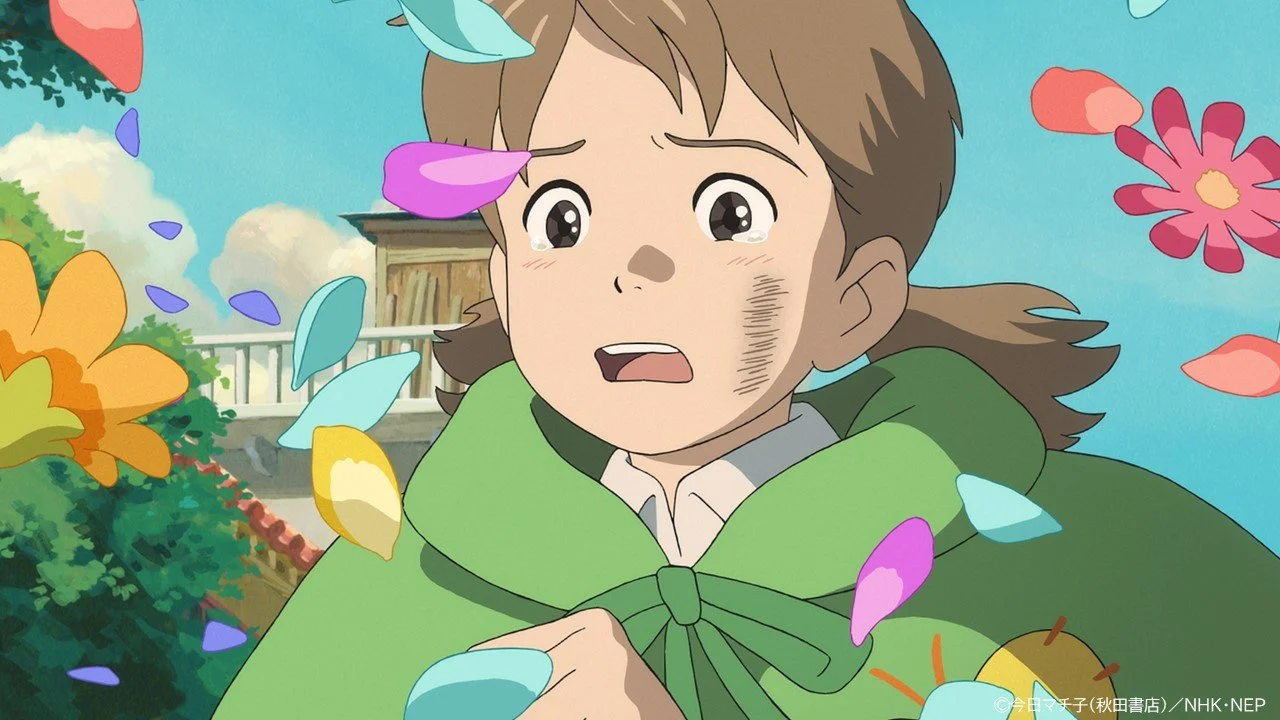
San witnessing a massacre with flowers masquerading the blood and gore.
YI: I really think it was great that [the manga] showed the gory parts, but once that becomes animation those gory parts are gonna have color and movement. So then, I think - for me - when I started this project I really wanted it to be a movie that teenagers could watch or like the younger generation could watch. So then I wanted to not lean towards like the shocking elements or the grotesque elements but more for the drama and the story. You know before it was just through casual talking with Tateno-san, like, we would just talk about, “Oh, the roses are pretty today, did you see them?”
And then that sort of came into the idea, but also, I think I might have been watching the movie E.T. around that time as well, and you know in E.T. his health is really connected to that flower, right? So when he's not feeling well, the flower sort of wilts and withers away. So I thought maybe, “Oh, we could physically show the condition of health using flowers.” So then I really wanted to expand on that idea. And that's how the flowers came about. Let me have Tateno-san answer as well.
HT: Yeah, the manga by [Machiko] Kyo-sensei is really graphic and gory, but we didn't really want to reject that idea either. We didn't change it to have negative connotations towards the manga, but I thought it was a little bit too direct if we put the color and the movement to all the realistic depictions of war. It would just be too much. And it's not like NHK put restrictions on us either, I think they were open to what we were gonna do. But I really wanted to make the movie more watchable.
And I don't think we're the first ones to exchange flowers for blood and it's not like we took any inspirations from any particular projects or films or works of art, but when I wanted to replace blood I really wanted to replace it with something that is beautiful but also scary. What I was thinking was “What is something that is so beautiful that it's sometimes so scary?”
Then when I was talking to director Ina and he was coming up with the image boards for the pitch that we were going to turn into NHK, he actually had some depictions of flowers in place of blood. And then we turned that in and because NHK had approved of it, I think they really understood what we were going for as well. I think they were able to resonate with our vision.
OH:That's wonderful to hear.
A question to Ushio-san, your artistic process fascinates me. For instance, in Liz and the Bluebird, you put ink on top of the musical score, folded it in half, and created mismatched patterns to depict the feelings of the two main characters slowly separating.
What is your approach this time with cocoon? How do you thematically craft a soundscape for a film depicting the loss of innocence in the midst of violence?
KU: When I got this project in my hands, when I thought about it, war is something that is so far away from Japan or typical Japanese people. I really didn't want to use some dramatic melody. I really wanted to make this a soundtrack that features everyday life or is part of our life; something that would happen to a friend in my class.
Because of the everyday life [motif], let's say take the piano, maybe the keyboard is making that shuffling noise or the hammers inside are making a noise. I really wanted to focus on the feeling of the texture from the piano into the soundtrack. That's the kind of method that I took when I was recording the soundtrack.
OH:Ina-san, Tateno-san, and Ushio-san. Thank you all very much for your time and contribution for this great film. Congratulations:
Ina-san for your excellent directorial debut
Tateno-san for launching Studio Sasayuri
Ushio-san for crafting a lovely soundtrack
I hope for the best in cocoon’s success here in the West!
cocoon: One Summer of Girlhood comes out on 4 September 2026. Click here for tickets
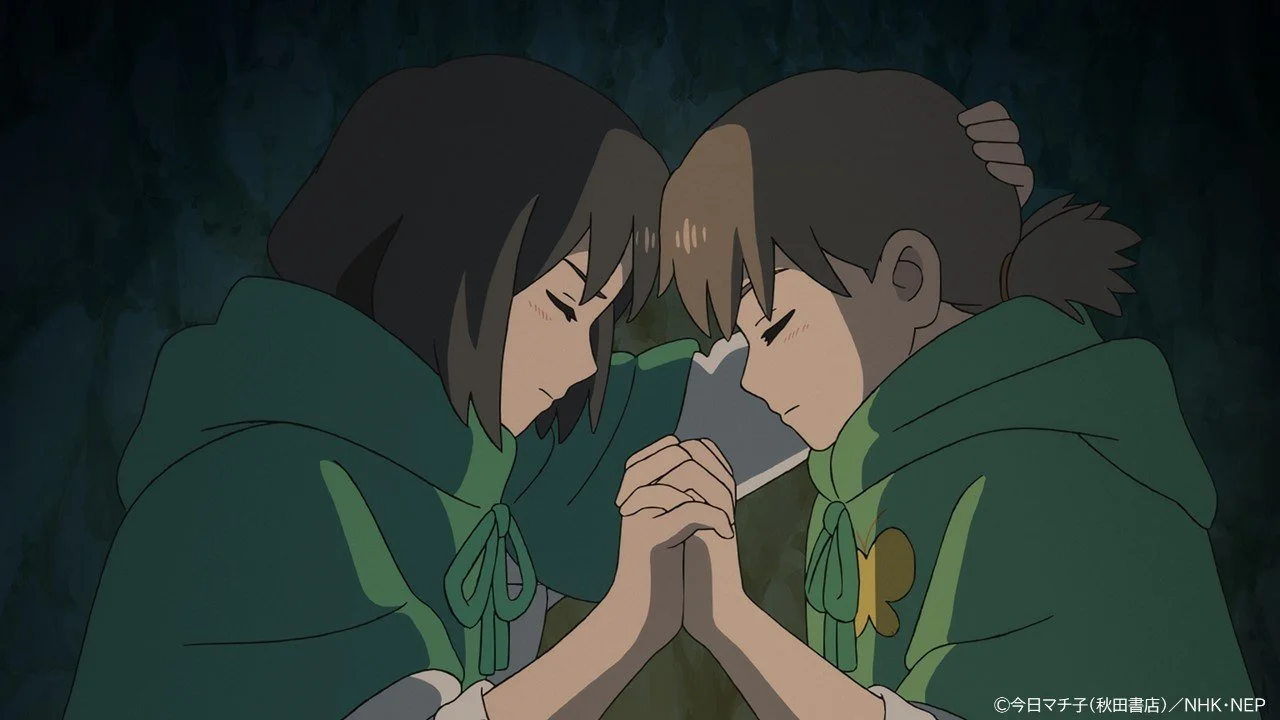
Mayu consoling San after air raids and caring for the injured soldiers.
Many thanks to:
Satsuki-san for being our interpreter for our interview.
Hannah Mancinelli and Joe Incollingo of 42 West LLC for the interview opportunity and coordination.
Grace Liriano and Rae D’Agnillo of GKIDS for the screener.
Christian Wiseman and Jon Sloan Jr. for feedback on interview questions.