
Labyrinth Movie Review
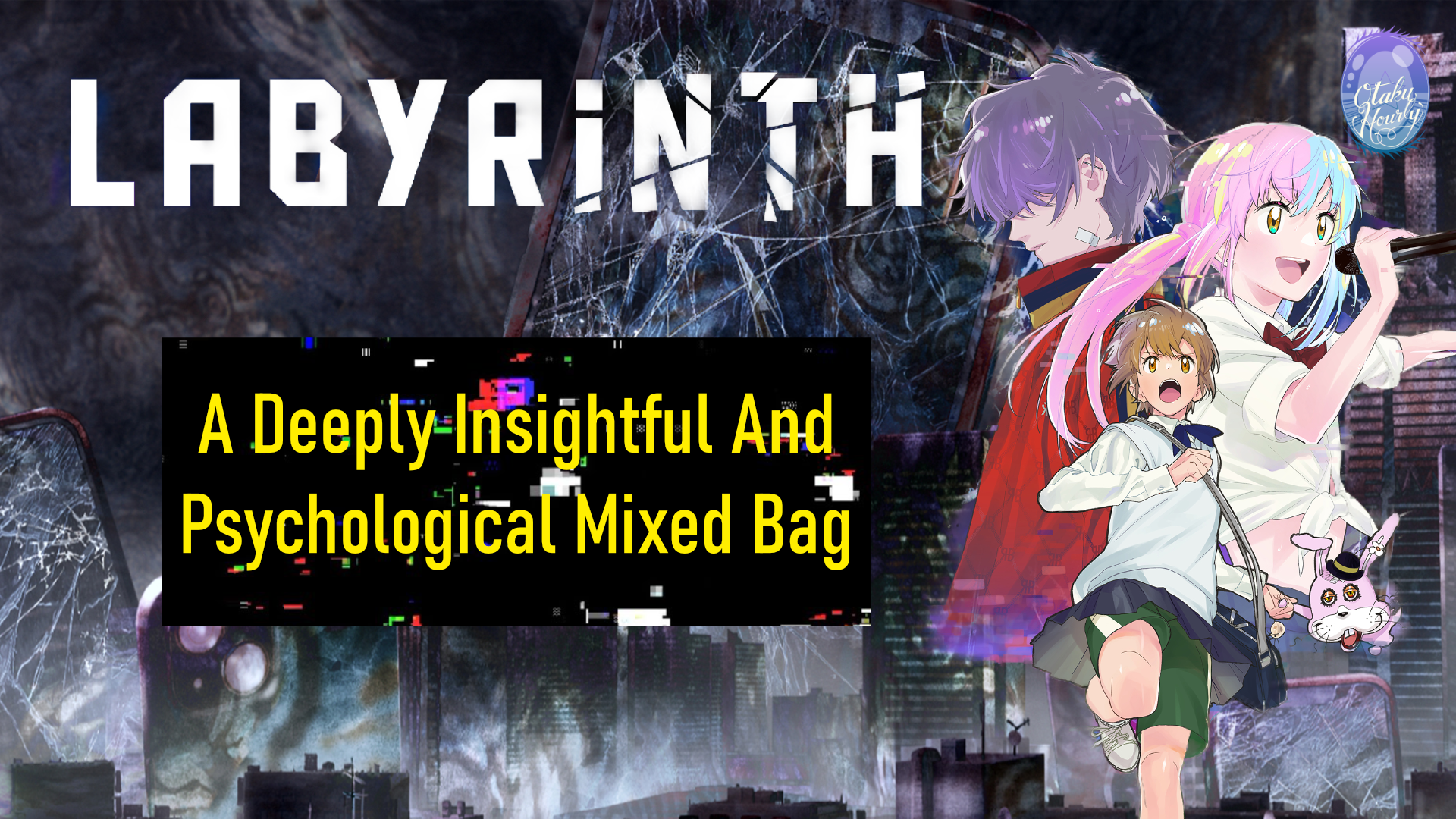
Labyrinth comes out in theaters 10 and 11 May 2026
by Jonathan “Joestar” Beltran
Mixed-bags are fun movies for a plethora of reasons. Sometimes there are distinct directorial choices that can puzzle you, other times there are unique messages told in baffling ways, and perhaps a few that strike a certain chord not a lot of people will understand. In short these types of films – and works of art in general - make it difficult to recommend, especially to a wider audience. All to say, I am making my case for Shoji Kawamori and Taichi Hashimoto’s original feature film Labyrinth.
Full disclosure I did receive a screener as well as an interview opportunity with the director for the film.
Shiori Maezawa is a high school girl who is deeply insecure in front of the camera; her image becomes a point of fixture where she has harbored jealousy of her best friend being more popular online than she. Eventually she runs into a haggard scientist with which she sees floating social media stickers (think emoji’s or reaction images used in Japan) and later finds herself trapped inside her smartphone. To add more complications her social media alter ego, a more extroverted and outgoing version of her, manifests into the world and tries to ultimately replace her by attaining 100 millions likes on the online world; asserting that the one the people choose is the version that gets to exist. It now becomes a race against time as Shiori and her sticker companion, Komori, try to get back home before it is too late.
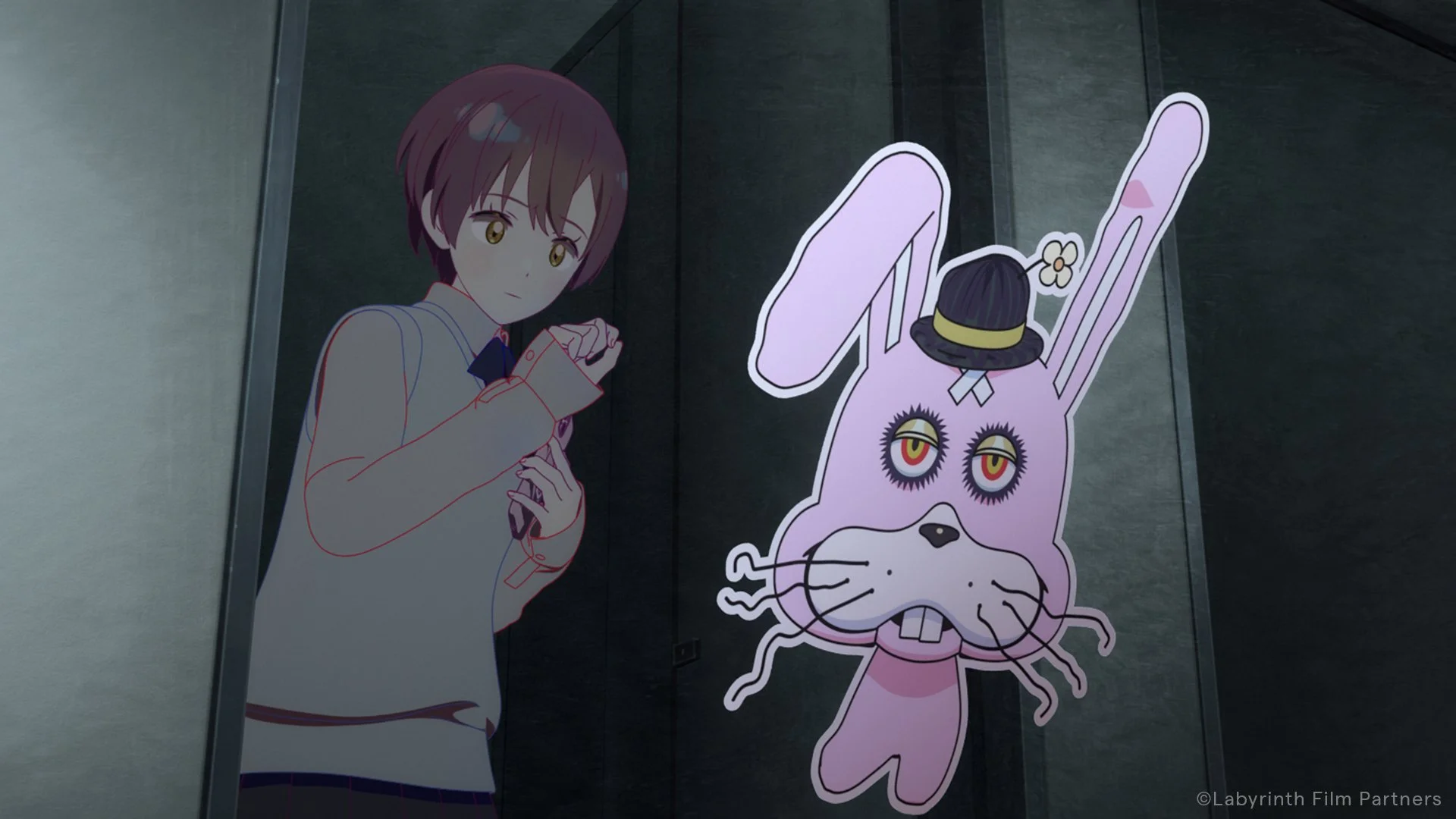
Main Characters - Shiori and Komori
The world found in Labyrinth is emblematic of “the road to hell is paved with good intentions.” Social media is not so much frowned upon as it is a phenomenon: equal parts a gauge of an ideal world where communication and connection are possible and equal parts a breeding ground for reducing humanity into a singular entity ala the sticker/stamp. There is an admirably gruesome scene involving silhouettes of people being crushed in agony, screams and digital blood and all, as they turn into stamps. These people have lost hope and connection to the real world and are reduced to muttering and murmuring icons. As the movie goes on, you learn more of how this world was initially created: a judgement-free haven. Ironically, it has become the very name of the movie, a labyrinth; empty, cold, gray, and hostile. When interviewing Kawamori-san he likened the notion of the phone being “an important part of me.” In this sense, it echoes what Marshall McLuhan mentions as “technology as being an extension of our bodies.” There is a clear relationship between the self we want to protect and the self we want to project. In the context of this movie, it becomes a battle for existence. Ergo, the crux of the story lies with Shiori Maezawa, or rather the two Shiori’s we find ourselves spending most of our time with.
Shiori character-wise is a clear cut main character: someone who seeks adoration and recognition through the joy of creation and performance yet feels the overwhelming pressures of judgement and ridicule amongst strangers. Her opposite, namely her alter ego, revels in the engagement involving everyone from her classmates and professors to her antics. She even goes so far as to give her rights to her image for billboards and other forms of advertisements for the sake of proving her (perceived) preferred existence. Both of them are two sides of the same coin and the movie makes it clear that not one is better than the other. While many people find the extroverted Shiori engaging, slander for introverted Shiori is at best imagined and at worst minimal. Social media, then in the film’s case, is an accessible avenue for that expression to be widely broadcast while simultaneously exacerbating the insecurities deep within. Labyrinth is a character study of the fragility of both egoistic extremes and argues that the reconciliation between one’s fragile ideal self and the insecure real self forge the courage to become one’s true self. The theme is powerful and relevant in an age where image and performativity are both the norm and concern for the younger generation. Given the message told, Shiori makes a great, if not perfect, character for this film.
Where it stumbles, however, are the narrative choices and its performances.
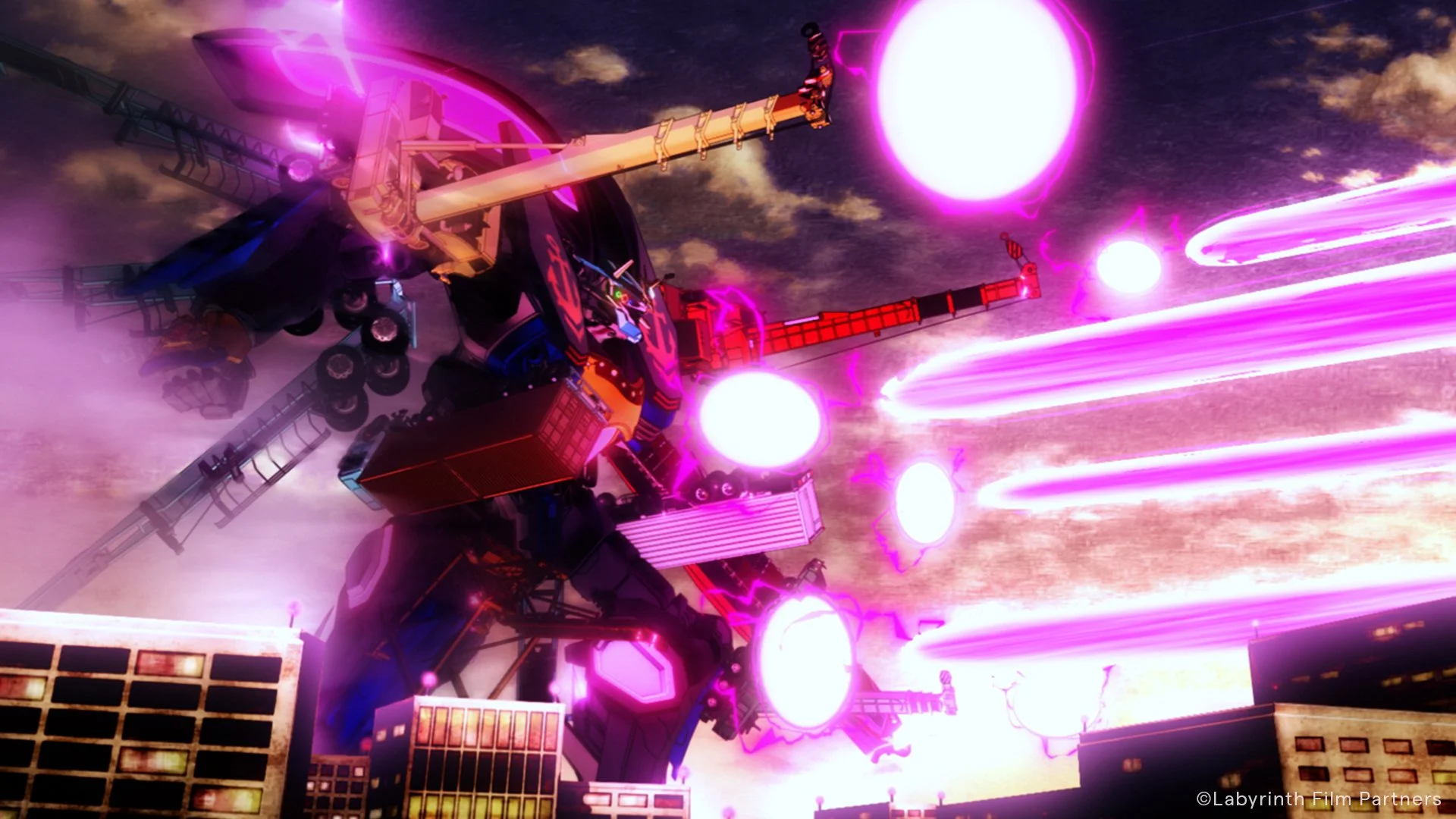
The mecha fight in question
First off, the mecha fight. In its defense, one can argue that it is a reversal of the usual trope: the good transforming robot and the giant monster. It is fascinating to see how this fight embodies the damage done on one’s being: the pilot of the robot can escape, much like an alter ego on a social media account; the monster is beaten, bruised, and bleeding - someone had to be whole to experience that pain. That being said, it is rather jarring. Yes, there is a mecha found on the programmer’s desk, including concepts of a bunny avatar - which will become the aforementioned giant monster - and it is still an abrupt tonal shift; a thematic one, though, I will give the movie that. Another caveat is given the Kawamori’s history in the Macross franchise where giant robots and idols are a mainstay. Take that how you will.
The other comes down to SUZUKA’s voice over performance as the titular main character. To the uninitiated, SUZUKA is the iconic member of the popular Japanese pop group, ATARASHI GALKO!!! and as much as she is an energetic tour de force, the portrayal comes across as stilted. Shiori’s voice does not have much vocal range when delivering screams nor tense dramatic moments when needed. There is a noticeably limited range in the delivery that I cannot help but feel that there is much left to be desired. I want to hear Shiori’s panic in life-or-death situations, yet SUZUKA’s portrayal comes off more anxious than sheer terror in these moments. All to say, there is not a lot of variation nor difference in the role and I feel there is so much left to be desired.
Lastly the animation can be hit or miss. It is not bad to be clear. Rather it begs the question of why the decision for 3DCG emulating 2D movement when a good portion of the film is standing, walking, running, and a dance here and there? It becomes mildly distracting, noting that the movie begins with 2D animation and the childhood memory scenes are depicted in 2D animation while the rest is the aforementioned. It is inconsistent, yet at best I think it does its job.
The ending, without giving too much away, gets into ridiculous proportions that only anime can deliver. This can either be the best part or the worst. Thematically it is on brand with Kawamori-san’s work: “Ever since I was in my 20s, like in Macross, instead of defeating the enemy with physical power, I really wanted to overcome it with songs or culture.” I think it all comes down to whether or not you enjoy the auteur’s choice. For me, it is both cheesy and charming.
The question lies here: would Labyrinth have found as much success without SUZUKA’s involvement? I do not think so. But then again, this is familiar territory given both of their works. I enjoy what creators Shoji Kawamori and Taichi Hashimoto have contributed to the greater array of animated works: it is timely and insightful in exploring the human condition through the black mirror. The inclusion of SUZUKA helps bolster attendance and sales. As much as I have enjoyed the psychological - albeit on the nose - portrayal of the warring desires between affirmation through attention and protection from humiliation that uniquely happens on social media, the moments leading up to the finale are silly at best and baffling at worst. Yet when combined, we have Labyrinth, a well-intentioned movie with messy parts and a deep reflective message; a mixed bag yet glad for its very existence.
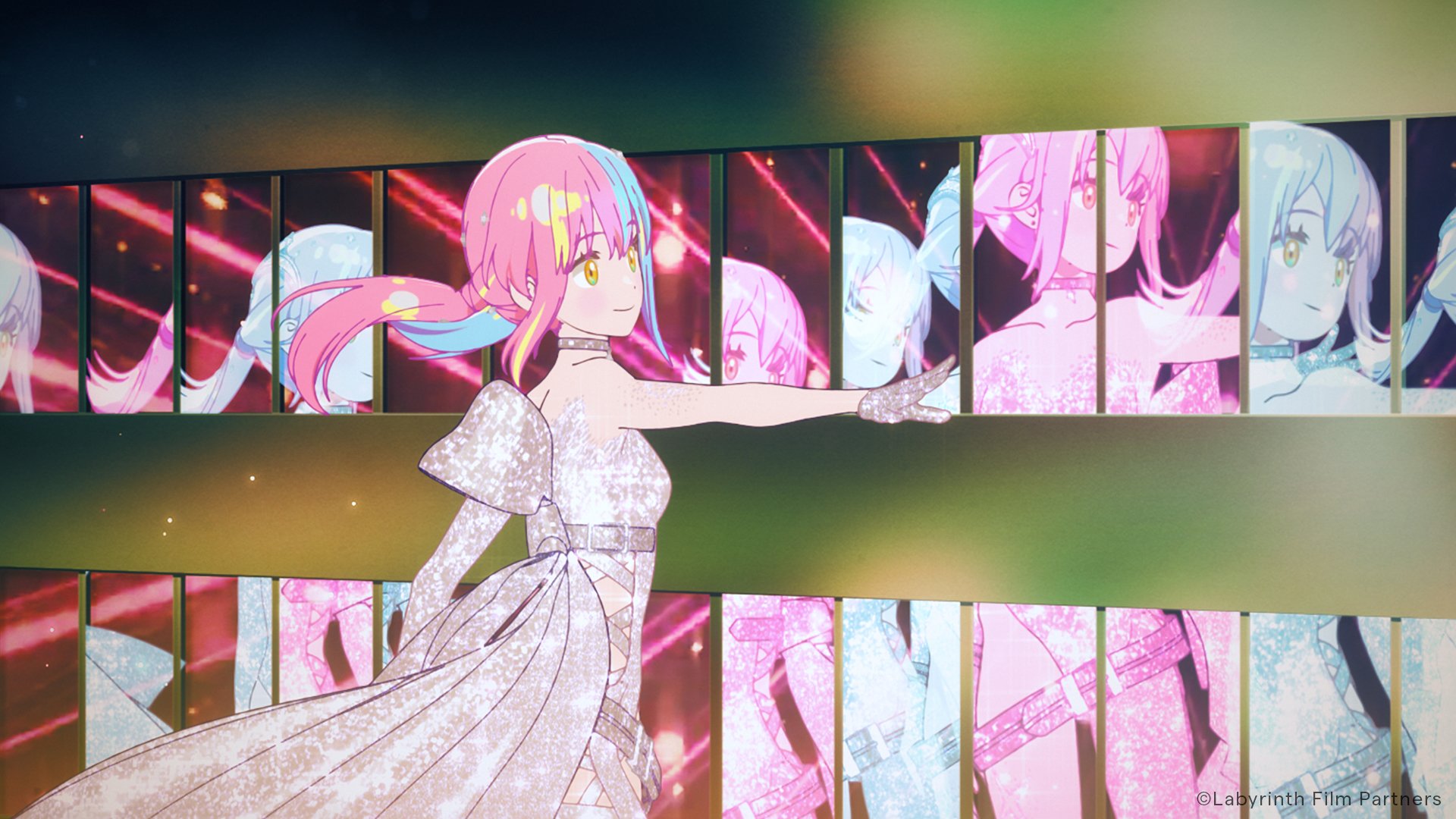
Alter ego Shiori
Many thanks to GKIDS and 42 West LLC for the screener.